What is a “classic” work of literature? What does Reddit think one is? When Reddit users talk about classic works of literature, which works are they talking about? I think it is worth pausing for a moment and trying to guess.
If you never spend time on the r/classicliterature
subreddit, I think that what Reddit calls a classic is a little
surprising. It isn’t completely shocking. The subreddit is full of
discussions of well-known works of literature. But they are a sort of
hodgepodge. r/classicliterature’s sense of a
classic aligns imperfectly with academic notions of
canonicity.
To investigate this, I counted all the works mentioned on
r/classicliterature. In the course of examining them, I
also considered the larger, and longer-lived, subreddit
r/literature, to provide some point of contrast for what
“classic” means. Of course, in so doing I realized that any serious
consideration of the reading practices of Reddit and its economy of
literary prestige would need to take into account subreddits like the
massive r/books, and the smaller r/TrueLit.
Indeed, once one starts looking, the whole matter balloons rather
absurdly. A total survey would surely need to include
r/RomanceBooks (more than twice the number of readers as
r/literature) and r/Romantasy and
r/DarkRomance, and perhaps even the smaller
r/HistoricalRomance. What about
r/suggestmeabook? If you perused these subreddits and were
surprised by the absence of science fiction, that is probably because
those discussions are collected in r/sciencefiction,
r/scifi, and r/printSF. The subreddits
r/Fantasy and r/FantasyBooks are likewise
sizable. This
list from the r/books wiki is probably the most
comprehensive list of book-related subreddits I’ve seen. It includes a
wide range of literature-adjacent communities, including author-specific
subreddits and subreddits on book binding. Ultimately, one realizes that
a serious inquiry into what Reddit considers “literature” and “classic”
would require tackling all of Reddit. What seems clear, though, is that
a process of self-organization has already sifted and sorted the
discussion of books on Reddit in such a way that
r/literature and r/classicliterature are
already in tension—not only with each other but with the wider
discussion of “books” and related concepts of “genre” (many of which are
not confined by a particular medium). And like any online community,
there have been conflicts and arguments and schisms. One detects a bit
of antagonism in the very name of the r/TrueLit subreddit
(which implicitly separates itself from those mere pretenders who
illegitimately claim the name of lit).(I haven’t examined r/TrueLit
here—though now I wish I had!) But classic does seem to
have an identity. People ask about one another’s “favorite classic.”
They look for advice in getting into “the classics.” So what particular
works are mentioned when people on r/classicliterature talk
about the classics? Let’s count ’em!
Of course, counting all the named texts is a tricky matter in its own
right. I used the wonderful download
tool provided by Arctic Shift.
It allows one to download the archive of all posts and comments for
particular subreddits on particular dates.Reddit itself, however, seems to not love its data
being made so easily downloadable. One Reddit user reports
being asked to remove torrents of reddit data; and another recent
thread suggests that links
to Arctic Shift are being removed from the platform. I
downloaded all of the posts and comments for both
r/literature and r/classicliterature and used
an LLM to extract every named author and work of literature. I may write
a separate post about that process, and offer a brief comparison of
conventional Named Entity Recognition tools with an LLM option.
(Spoiler: the LLM was better.)
But let’s look at the data as I have it. First, a quick overview of activity on these two subreddits.
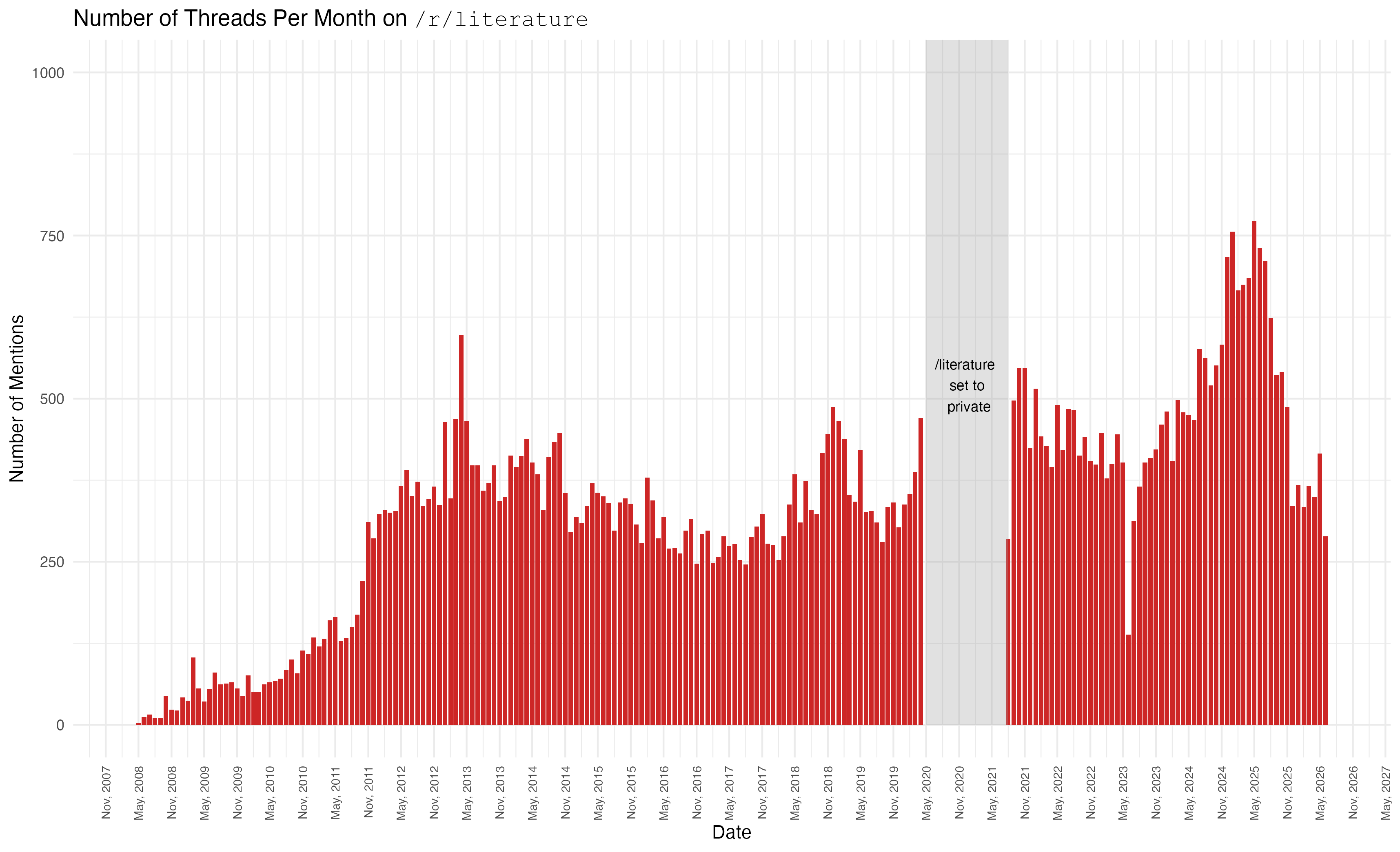
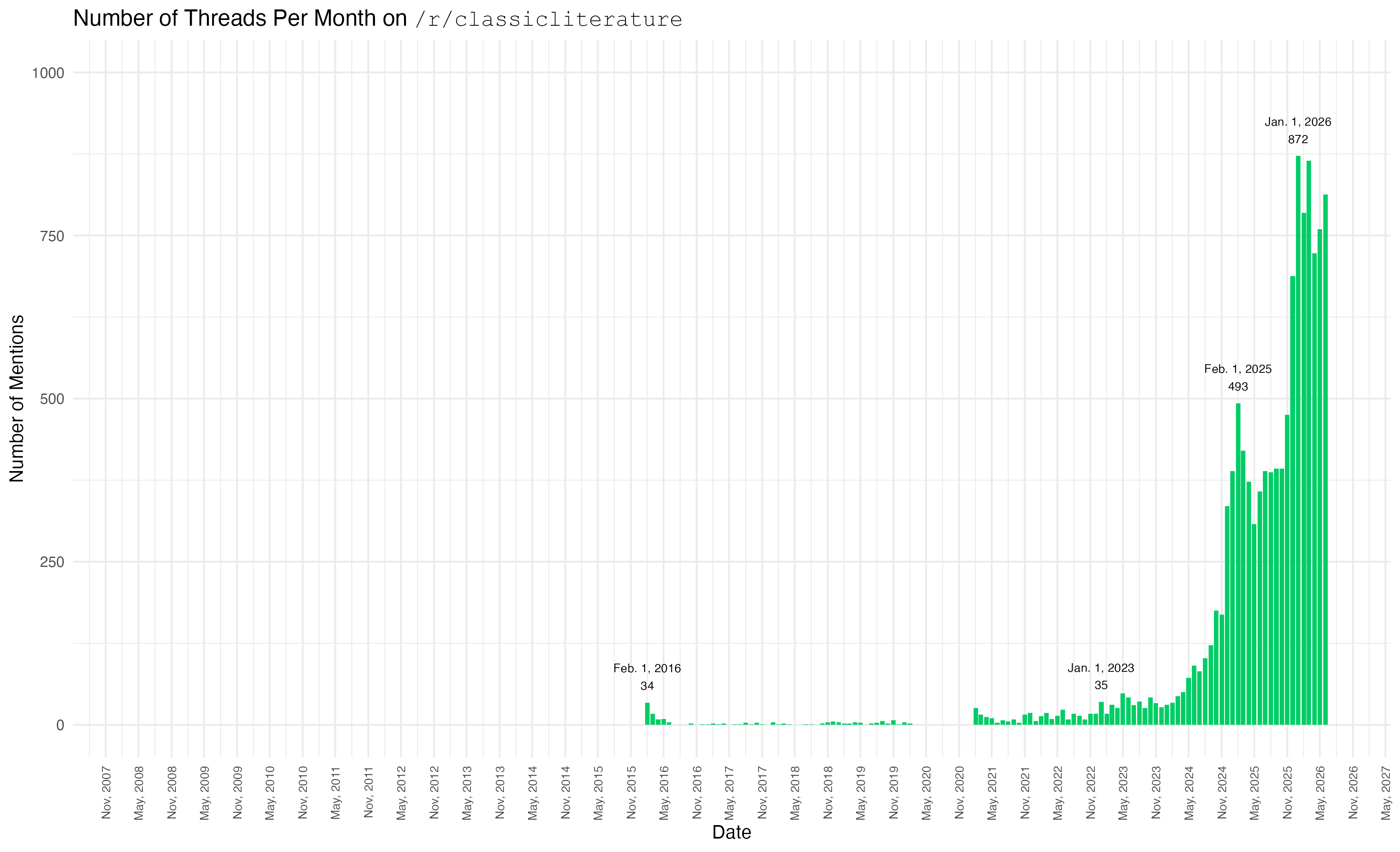
r/literature is the older of the subreddits, starting
soon after Reddit was established as a platform. While
r/classicliterature has its first posts in 2016, it doesn’t
really take off until around 2020. Interestingly, it grew during a
period when r/literature went private (for reasons that
seem to involve a disagreement among the subreddit’s moderators). Since
2024, r/classicliterature has grown rapidly and in recent
months has seen more activity than r/literature.
Let’s look at the particular works of literature that are discussed in these fora, starting withthe top 100 most frequently mentioned works in these two subreddits.
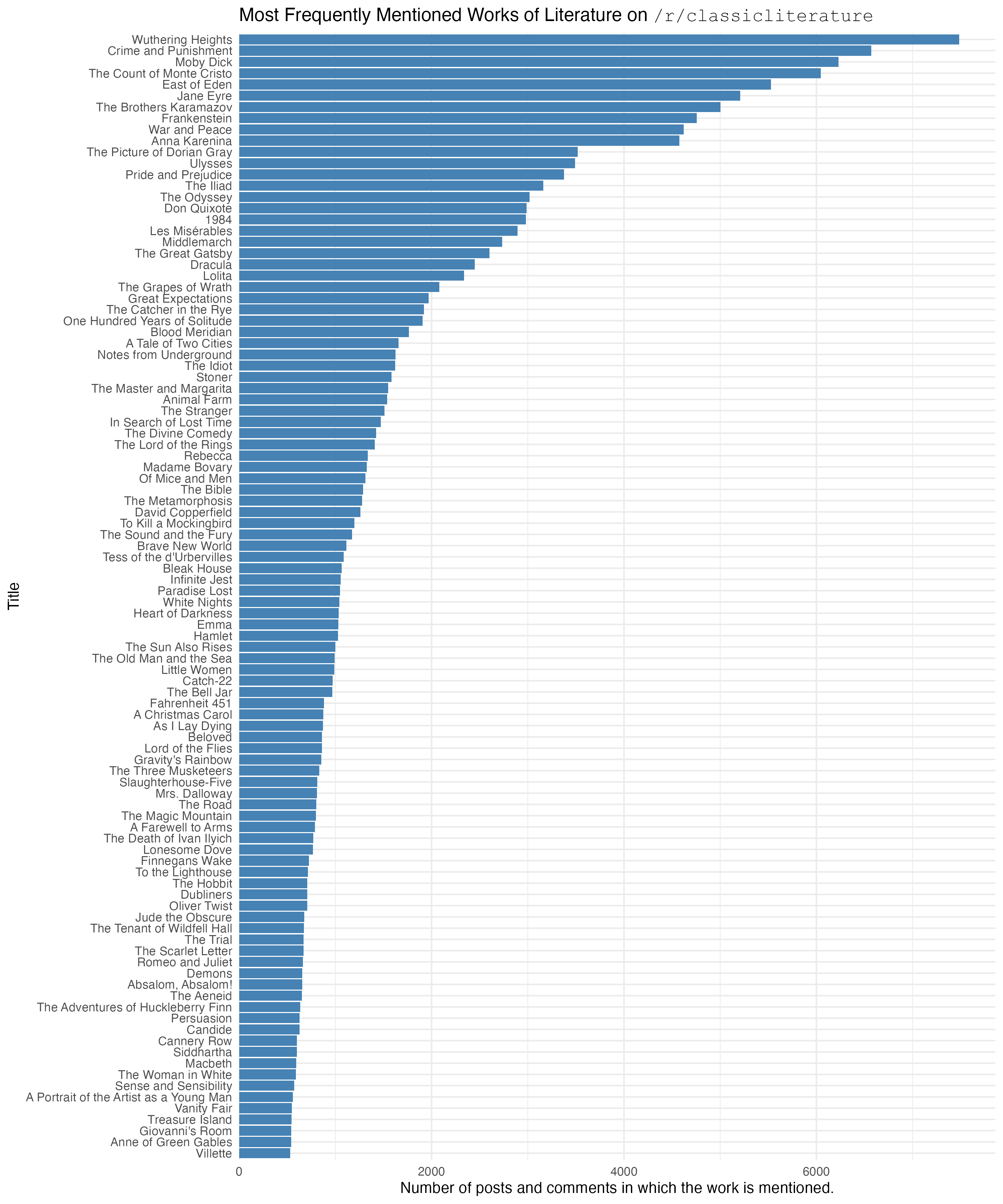
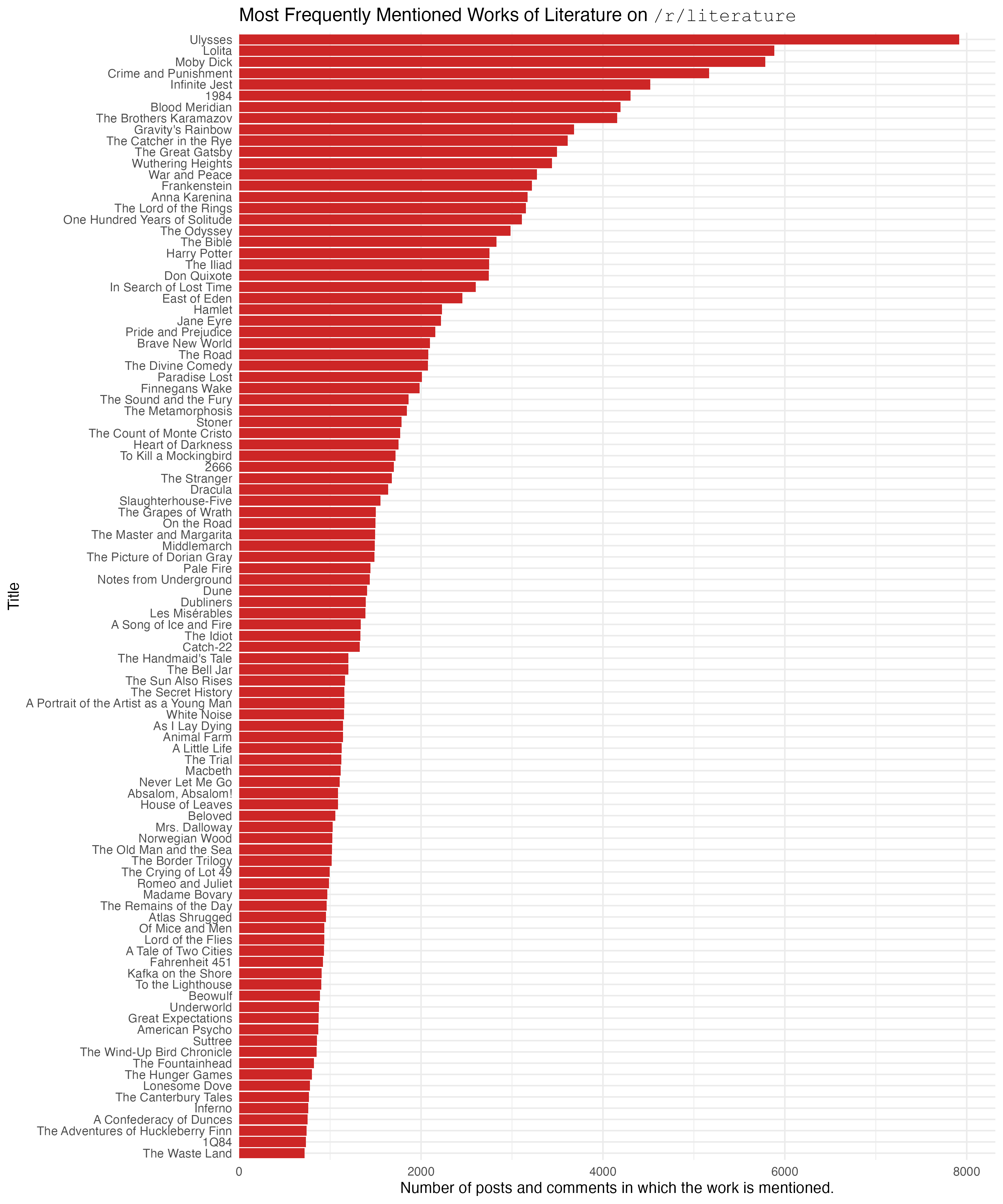
These lists resonate with Melanie Walsh and Maria Antoniak’s
excellent essay “The Goodreads
‘Classics’: A Computational Study of Readers, Amazon, and Crowdsourced
Amateur Criticism.” Walsh and Antoniak collected works on Goodreads
that were tagged classic and analyzed the associated
reviews to examine how the “classics” are imagined on that platform.
Walsh and Antoniak’s data provides a useful point of comparison for
these two subreddits. For additional points of comparison, we can also
highlight works that appeared in the
Modern Library’s (infamous?) top 100 novels of the 20th century
list, as well as works that Harold Bloom identified as part of the
“Western Canon” in the appendix to the (infamous!)
book of that title. These points of comparison help characterize
what Reddit considers a classic. I’ll highlight a few things.
A Classic is Not a Poem
The top works on these subreddits are completely dominated by
narrative forms, and are almost exclusively (~90% by my hand
count) novels. No lyric poetry appears at all; what poetry does appear
is epic narrative (Homer, the Aeneid, Paradise Lost).
Whatever classic literature is, it isn’t lyric poetry. The absence of
lyric poetry is just one of the ways that Reddit’s definition of
literature has been narrowed so that literature becomes largely
novels. I don’t think this means interest in poetry has
necessarily waned. There is a rather vibrant r/poetry
subreddit, comparable in size to r/classicliterature and
r/literature. But the language of the “classic,” to judge
from these subreddits, has attached to narrative fiction. (And this, I
think, is mostly true of Walsh and Antoniak’s Goodreads data as
well.)
A Classic is (Probably) Russian or Victorian
I think we can get some additional insight into these categories by
comparing the works that are distinctive of each of these communities:
/r/classicliterature/, r/literature, and the
works tagged “classic” on Goodreads, and comparing what works appear in
the top 100 of each.
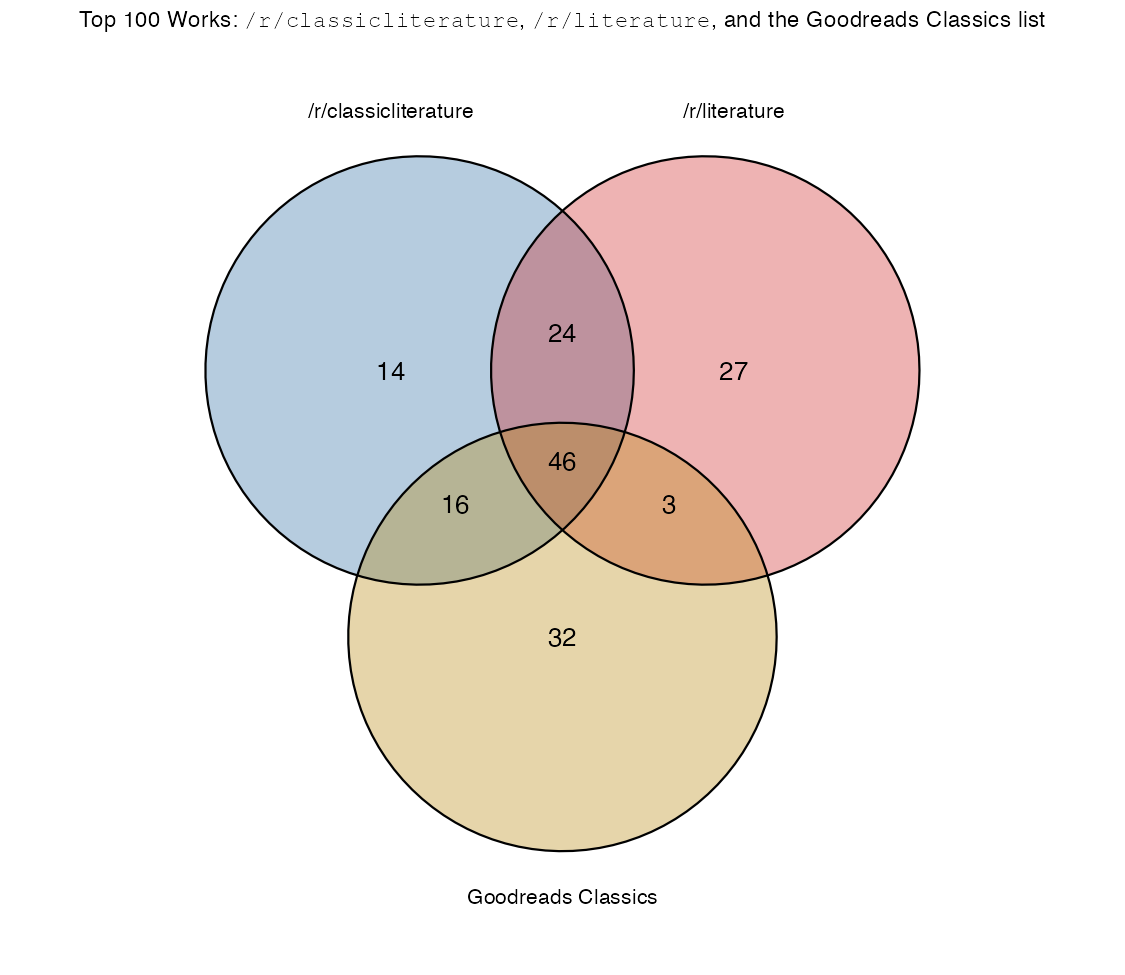 If you want the titles, the diagram is a little
crowded.
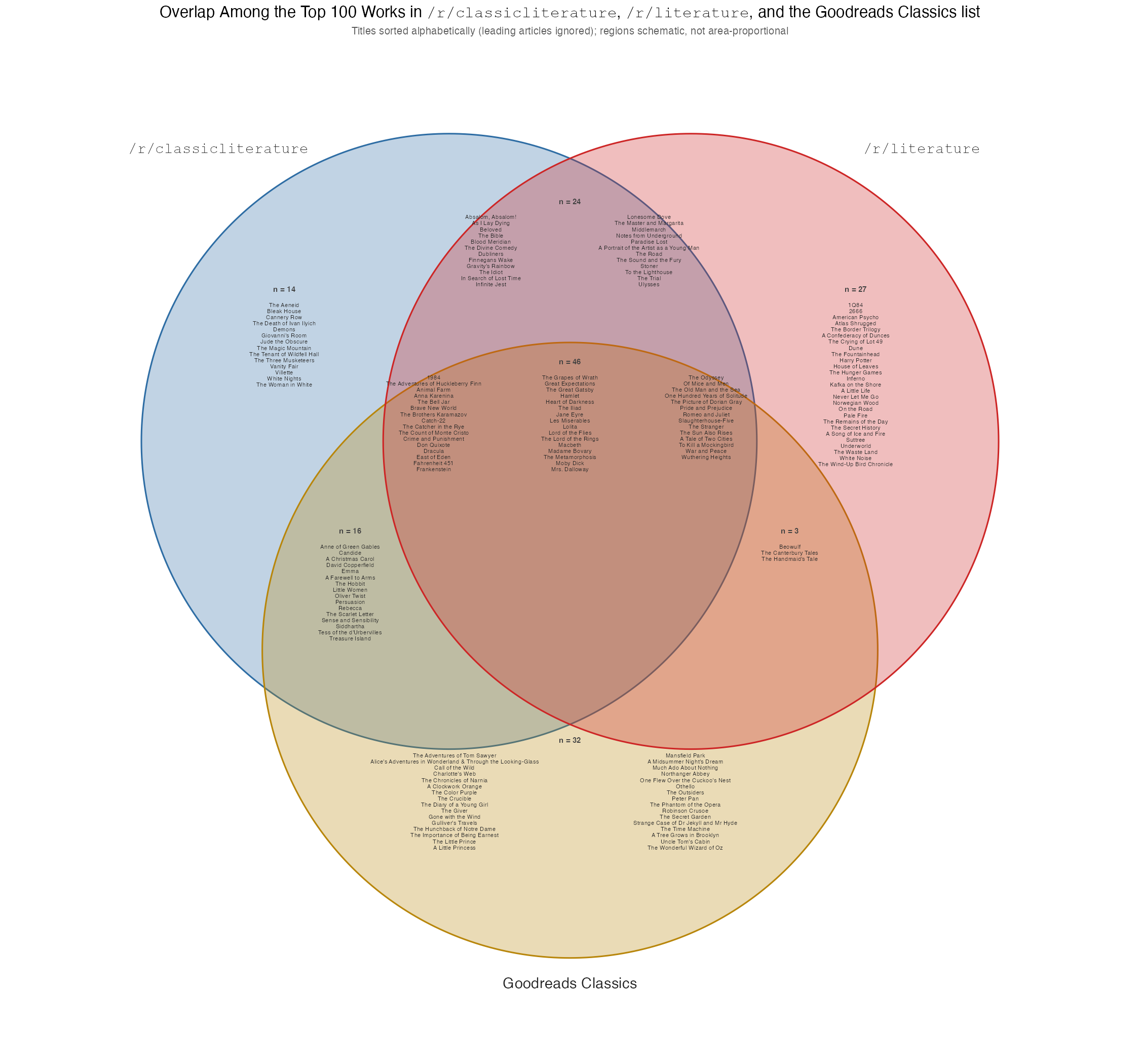
Works distinctive of r/classicliterature are mostly
nineteenth-century fiction. r/classicliterature’s top 100
contains lots of Victorian novels: Dickens’s Bleak House,
Thomas Hardy’s Jude the Obscure, Anne Brontë’s The Tenant
of Wildfell Hall, Charlotte Brontë’s Villette, Wilkie
Collins’s The Woman in White, and William Thackeray’s
Vanity Fair. But there is also a significant helping of Russian
lit: Dostoyevsky’s long short story “White Nights” and Demons
and Tolstoy’s The Death of Ivan Ilyich. The other works unique
to r/classicliterature’s top 100 are Thomas Mann’s The
Magic Mountain, Virgil’s Aeneid, and Steinbeck’s
Cannery Row, as well as Alexandre Dumas’s The Three
Musketeers.
By contrast, the works in the top 100 of r/literature
that don’t appear at the top of either /r/classicliterature
or Goodreads tend towards the twentieth century. They include a few
popular book series: Harry Potter, The Hunger Games,
Dune, A Song of Ice and Fire, but also some works that
are frequently discussed on Reddit (Ellis’s American Psycho,
Bolaño’s 2666, Tartt’s The Secret History,
Yanagihara’s A Little Life) as well as a smattering of
twentieth-century novels like Pale Fire, On the Road,
The Crying of Lot 49.For this
analysis, I condensed all books in a series—say, Harry Potter
or Dune—to a single title; that may overrepresent them, but it
seemed the best compromise for my purposes.
Thirty-two works are unique to Goodreads classics.1 Walsh and Antoniak describe a “clear influence of school systems on Goodreads users’ conceptions of the classics” (270). And certain of the Goodreads-specific texts indeed seem to reflect US public school curricula. Charlotte’s Web, The Crucible, The Giver, and The Outsiders are all unique to Goodreads, and savor distinctly of middle school English class. Reddit’s discussions seem less yoked to school readings. I’m not sure why. Perhaps discussion on Reddit is more aspirational, for finding books people want to read in the future, while readers are using Goodreads to record all the books they’ve read.
A Classic is Old
We can also get a sense of the relative historical orientation of
each of these communities with a nice visualization Walsh and Antoniak
offer. They plot popularity (as measured in number of Goodreads ratings)
by publication year, to get a sense of how the Goodreads classics are
distributed over history. I’ve reproduced their visualization, along
with similar plots for r/classicliterature and
r/literature. One note: because so few works in the dataset
are published before 1800, I’ve limited the plot to works published
after 1800.2
A Reddit classic is old. Among these three communities,
r/classicliterature skews to the left, with the oldest
works; Goodreads “classics” are the newest works, with
r/literature in the middle.
A Classic is Canonical(ish)
Walsh and Antoniak note that “classic” is the category users rely on
far more than the academic-sounding term “canon” (270), a word which, they note,
hardly appears at all in Goodreads users’ reviews.3 If
we take the list of texts from Bloom’s Western Canon as one
measure of what constitutes the “canonical,” we can measure the
canonicity of these communities by simply seeing how many works in their
top 100 appear in Bloom’s list.This is a
somewhat silly measure; Bloom’s list is very long. It contains more than
1,500 works, and reflects Bloom’s idiosyncratic choices: e.g., Toni
Morrison’s Song of Solomon is included, but not
Beloved. If Lisa Nakamura is right to note that on
Goodreads “reader tastes reflect the traditional literary canon more
closely than one might expect” (240; qtd. in Walsh
and Antoniak 254), Goodreads nevertheless has the least overlap
with Bloom’s list of these three communities. 37 of the works in
Goodreads top 100 are on Bloom’s list, compared with 55 of
r/literature and 66 of r/classicliterature. A
Reddit classic is surprisingly well aligned to at least Bloom’s notion
of canonicity.
The Classics are a Little Weird
All of which fails to account for the puzzled feeling I had reading
the ranking above. Particular works often surprised. Wuthering
Heights is great. But is it really number 1? And, weirder still:
what is up with The Count of Monte Cristo? The Count of
Monte Cristo ranks 36th on r/literature and 18th on
Goodreads’s top 100 classics, but it is 4th on
r/classicliterature. Have I simply missed this novel’s
centrality to literary history? And, if I missed it, I am not the only
one. It is absent from Bloom’s The Western Canon. The YouTube
channel “Man Carrying Thing” recently
highlighted the weird, and indeed recent, emergence of The Count
of Monte Cristo as what he calls “gen z’s new favorite book” and
the “gateway drug into classic literature for tons of people.”
One reason for the high ranking of these two works appears to be film and television adaptations.
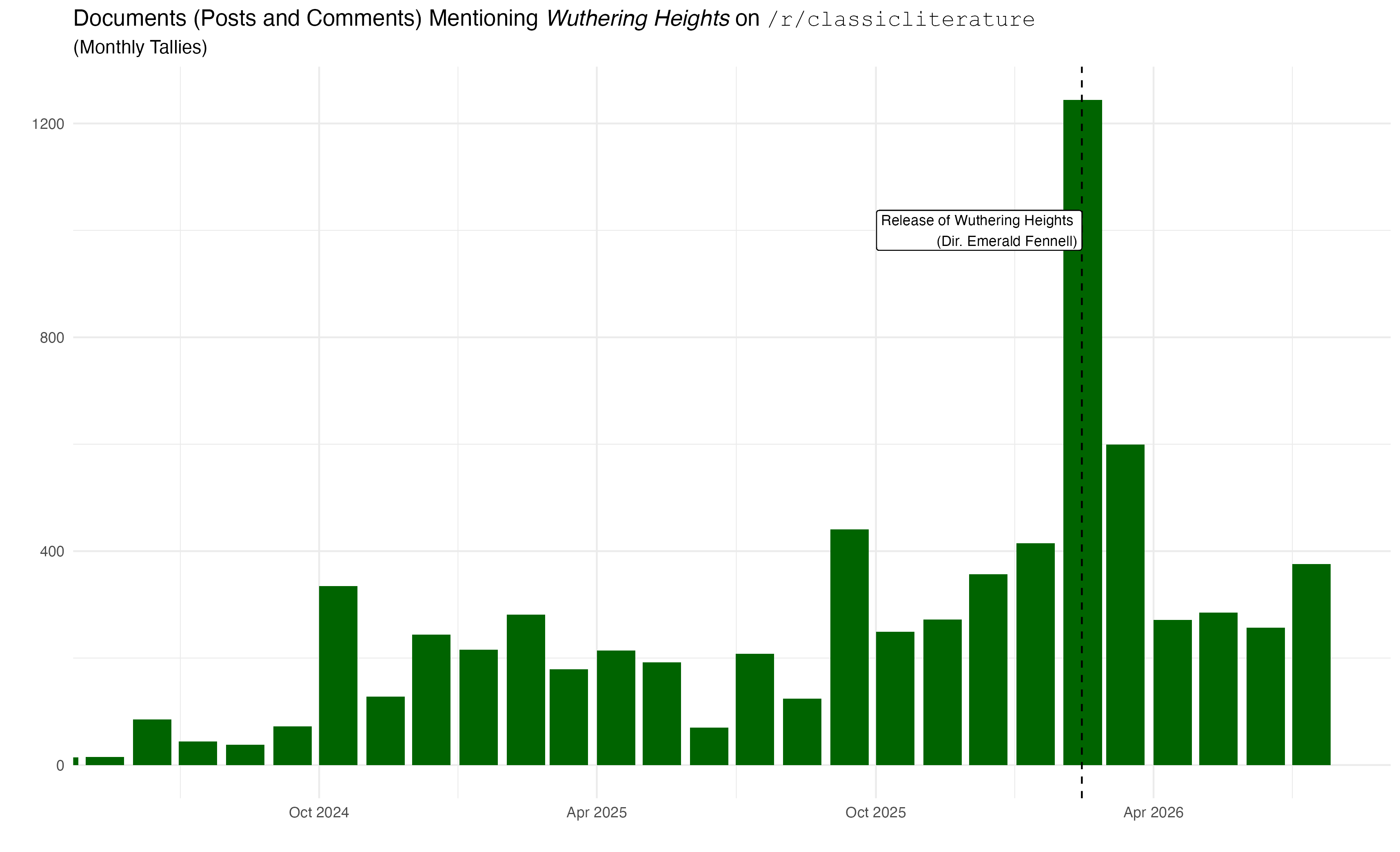
As the chart above suggests, Wuthering Heights was widely
discussed on r/classicliterature before the film’s release;
but there is a clear spike in the month of the adaptation’s release.
Indeed, the film was announced
in July 2024, making the rise in posts on
r/classicliterature essentially coextensive with the
anticipation for Fennell’s adaptation. It is not impossible that the
film alone shaped Reddit’s notion of what “classic literature” is.
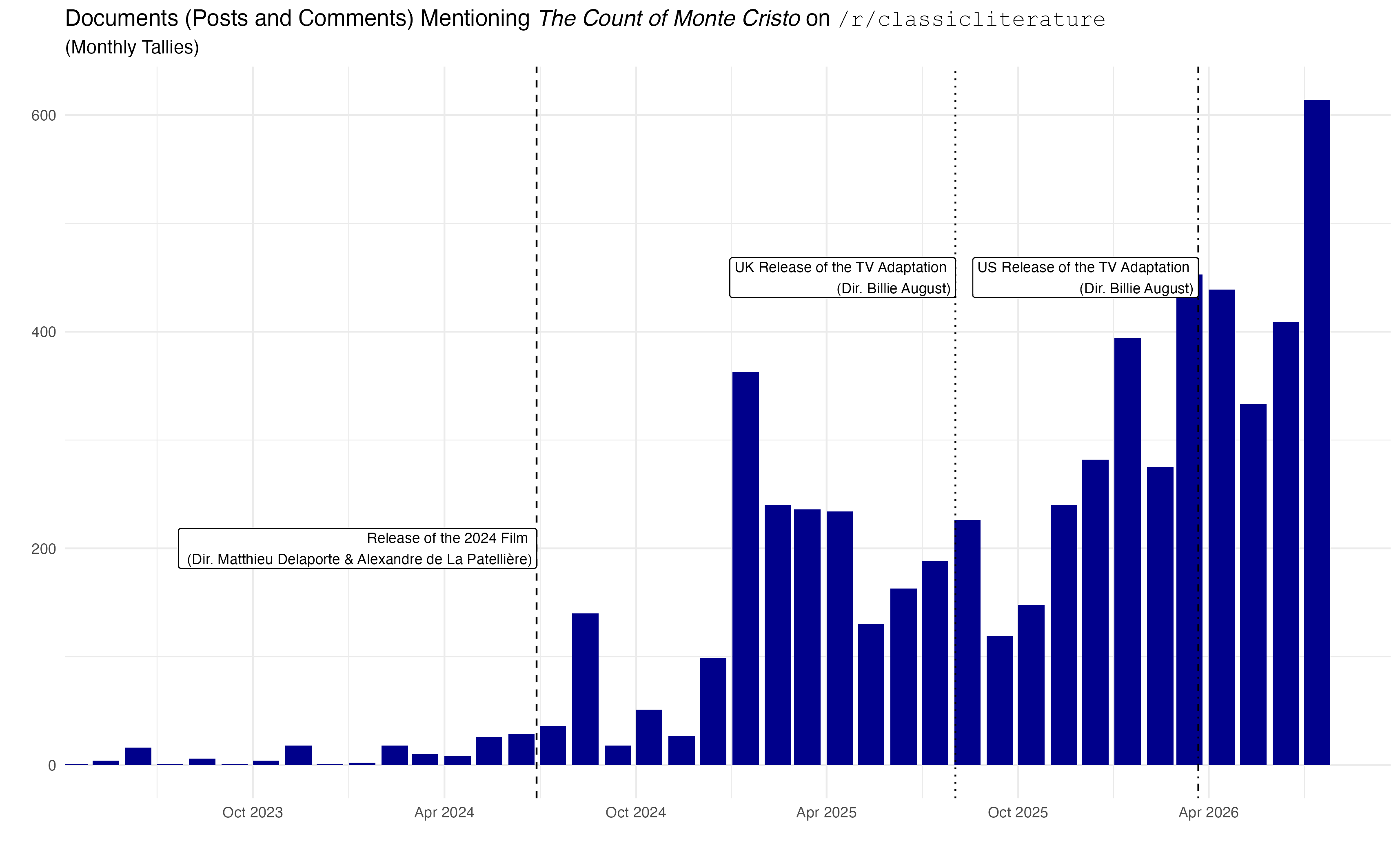
The situation is somewhat similar with The Count of Monte Cristo. While the spike is more diffuse and less well-defined, it seems that a 2024 French film adaptation, and then a British TV series (broadcast in the US in March 2026), helped support the increased discussion of Dumas’s novel. I wonder what was going on in discussions of literature on TikTok? Was TikTok getting excited about Dumas’s novel at just this moment?
If we generate Dunning Log Likelihood scores on the text of the posts
associated with each of the top works in
r/classicliterature we can identify terms most distinctive
of each work.Ted Underwood’s post “Identifying
diction that characterizes an author or genre” introduced me to the
range of methods for identifying characteristic diction.
Here are the top 100 terms distinctive of posts/comments mentioning Wuthering Heights:
heathcliff bronte wh cathy catherine jane eyre nelly emily romance heathcliff’s linton hareton hindley lockwood isabella earnshaw romani edgar movie dark gothic romantic she moors abuse yorkshire race heathcliffe characters tenant gypsy pp sisters black white brontes irish austen charlotte bronte’s elordi wildfell toxic cathy’s revenge skinned hall love prejudice her fennell catherine’s frankenstein casting adaptation liverpool grange pride obsession ethnicity lintons lascar ambiguous generational trauma dialect emerald film jacob asian skin arden described robbie nelly’s story racially adaptations unlikeable thrushcross people racial withering healthcliff vocab roma margot joseph’s emily’s indian hair darker earnshaw’s relationship critics rebecca je toxicity heathcliffs
Many of the terms are character names (Heathcliff, Cathy, Nelly,
Hareton, Hindley); others are key themes (romance/obsession). There are
discussions of Heathcliff’s ambiguous racial identity (“romani,” “dark,”
“skinned,” “ethnicity,” “ambiguous,” “irish,” and “indian”), and many
seem to come from comparisons in posts about Wuthering Heights
to other works (Charlotte Brontë’s Jane Eyre, Anne Brontë’s
The Tenant of Wildfell Hall, Jane Austen’s Pride and
Prejudice).And, of course, typos:
healthcliff, heathecliff,
withering. But the bolded terms, I assume, must come
from discussions of the film adaptation.
I think we see a similar, though less pronounced, trend in the top 100 terms distinctive of The Count of Monte Cristo:
dumas revenge dantes edmond musketeers christo alexandre montecristo tcomc les mercedes comc bce adventure miserables abridged peace buss haydee unabridged danglars three robin pages war mis quixote prison villefort faria fernand long brothers lonesome east don punishment eden karamazov crime dove d’if critics rome areadingofmontecristo french morrel karenina vengeance hippo tulip serialized chateau hugo version century fun count’s length plot leo chocolate valentine anna miniseries abbe mc counte turner finished action comte vampa tcmc r page th benedetto paced imprisonment augustine badel nishapur classics next cheng’en edmond’s arabian blanc albert kempis claflin anycount size exeter treasure escape le slow attar
Again, there are abbreviations (CoMC, TCMC), key themes (revenge), references to editions (the Robin Buss translation; abridged vs. unabridged). The number of terms here that come from other titles (Les Miserables, The Three Musketeers, East of Eden, War and Peace, Crime and Punishment, Brothers Karamazov) makes me wonder how many of these posts are simply lists (“Top 10 Classics,” etc). But we also see discussion of the miniseries and actors like Sam Claflin and Alan Badel (from the earlier, 1964 adaptation). Anna may be Ana Girardot, who plays Mercédès, and Leo may be “Leo Harris” who plays Villefort, both from the recent TV adaptation. There are fewer words here related to adaptations than in discussions of Wuthering Heights, but I’m still willing to suggest that the reception and discussion of classics is often shaped by adaptations.
I don’t think all of the sense of miscellany I find looking at
r/classicliterature‘s top 100 can be explained by
adaptations. But they definitely play a part. It reshapes readers’
interests and sense of what is important, and so elevates some works in
ways that are surprising. There are, no doubt, other forces shaping
reader interest. Perhaps they can help explain how and why Dostoevsky
has emerged as the subreddit’s most mentioned author.
A Classic is Not a Social Media Post
Walsh and Antoniak conclude,
So what is a ‘classic’ in the twenty-first century? Based on our analysis of 144 Goodreads classics and 120,000 accompanying reviews, there are at least a few clear answers. For Goodreads and Amazon, a classic is a prominent advertising target value, a marketing tool, and a source of lucrative adaptation material. For Goodreads users, a classic is a book read in high school, a book that inspired a TV show, or a book that other Goodreads users have tagged as a classic. (Walsh and Antoniak 276)
The works of r/classicliterature have a lot in common
with this description of Goodreads classics. They are influenced by
adaptation in a similar way. They appear less indebted to high school
curricula. They are, if anything, more canonical than those of
Goodreads; and they definitely tend to be older. But any appeal
to the classic is an attempt to claim the cultural capital invested in
the idea of literature and literary reading. Online, at this moment,
such a claim occurs at a moment when literature’s value and prestige are
called into question.
In that environment, the pastness and even out of
stepness that are ascribed to the “classics” by
r/classicliterature is essential. In reimagining a
collection of texts as “classics,” the subreddit establishes a
“selective tradition,” defined implicitly against a dominant culture.
Raymond Williams’s description of the resistant power of residual
meanings and values is reflected in the attempt to establish “the
classic” as something at odds with the dominant media enviroment.
at certain points the dominant culture cannot allow too much residual experience and practice outside itself, at least without risk. It is in the incorporation of the actively residual—by reinterpretation, dilution, projection, discriminating inclusion and exclusion—that the work of the selective tradition is especially evident. This is very notable in the case of versions of ‘the literary tradition’, passing through selective versions of the character of literature to connecting and incorporated definitions of what literature now is and should be. This is one among several crucial areas, since it is in some alternative or even oppositional versions of what literature is (has been) and what literary experience (and in one common derivation, other significant experience) is and must be, that, against the pressures of incorporation, actively residual meanings and values are sustained. (Williams 123)
r/classicliterature is a selective version of the
literary tradition. To a literary historian the absence of lyric poetry
from its account of the “classics” is surprising; as, I think, are the
particular works it elevates. But if we understand the classics as a
reaction formation to social media it may be less so. A classic is
something from a time before and, most crucially, a time before
social media, and short-form social media (like TikTok, Reels, and
Twitter) in particular. Without being flip, I think The Count of
Monte Cristo ends up as one of the key “classics” because it is
so long, and that signals that it is not TikTok or Twitter.
The Reddit classic is just one interpretation of the place of literature in the media environment of the present. Different, less antagonistic ways of imagining the relationship between social media and literature exist. After all, lyric poetry—so notably absent from Reddit’s classics—is short-form media avant la lettre. It certainly appears like the literary form best suited to the era of TikTok and Instagram reels. And, in some ways, it thrives there. “Instapoetry” too is a “selective version” of literature. In that version, however, poetry is not in antagonistic relationship to social media. Appeals to the idea of the “classic” are far less present there. Instead, in Rupi Kaur (only the clearest example of a reconciliation of poetry and social media), value manifests not as “classic” but as something like emotional earnestness.4
r/classicliterature expresses a vision of literature and
literary value, I am suggesting, that is meaningfully opposed to the
dominant media ecology. It is opposed to social media in a way that
Instapoetry cannot be. But in so valorizing the old, it risks
thoughtlessly importing a very conservative vision of what literature
is. Walsh and Antoniak note that “the Goodreads classics are
considerably less diverse in terms of race and ethnicity of their
authors” (254). The top 100 of
r/classicliterature is even less ethnically diverse and,
despite Emily Brontë taking the top spot, it is pretty male (as evident
in the mentions vs. publication date plots above, which are color-coded
by author gender).
So a final, possible definition. A Reddit classic is a work in antagonistic relationship to the media ecology of the present. That antagonism is not absolute (one signals one’s devotion to the classic on social media after all), but the idea of the classic as old and long reshapes ideas of canonicity to stress a difference from contemporary social media. The Reddit classic is an instance, in Williams’s words, of imagining “alternative or even oppositional versions of what literature is.” Here, I am suggesting, that opposition is implicitly to the wider media ecology where the values we conventionally associate with literature are receding into the past. Under such a definition, a book, like The Count of Monte Cristo, that may not be traditionally canonical, emerges as a classic. But this reshaping and reimagining of what literature is, while alternative and oppositional in some regards, is not without problems of its own.
Notes
If you’re interested in the data behind these plots, I’ve made a digest of the works mentioned available in a zip.
Per my habit recently, LLMs were used for data extraction and for generating the code behind some of the plots. The prose, however, is all mine.
Sept. 7 Update: After publishing the first version of this post, I noticed an error. Works that have a number in their title were sometimes undercounted by not merging different versions of the titles. Thus, redditors would refer to both 1984 and Nineteen Eighty-Four, and 100 Years of Solitude and One Hundred Years of Solitude. I used LLMs to find all such instances and merge them. The only affect in the top 100 rankings were on those two titles already mentioned. The new versions are above.
Works Cited
They are: “The Adventures of Tom Sawyer” “Alice’s Adventures in Wonderland & Through the Looking-Glass” “Call of the Wild” “Charlotte’s Web” “The Chronicles of Narnia” “A Clockwork Orange” “The Color Purple” “The Crucible” “The Diary of a Young Girl” “The Giver” “Gone with the Wind” “Gulliver’s Travels” “The Hunchback of Notre Dame” “The Importance of Being Earnest” “The Little Prince” “A Little Princess” “Mansfield Park” “A Midsummer Night’s Dream” “Much Ado About Nothing” “Northanger Abbey” “One Flew Over the Cuckoo’s Nest” “Othello” “The Outsiders” “Peter Pan” “The Phantom of the Opera” “Robinson Crusoe” “The Secret Garden” “Strange Case of Dr Jekyll and Mr Hyde” “The Time Machine” “A Tree Grows in Brooklyn” “Uncle Tom’s Cabin” “The Wonderful Wizard of Oz”.↩︎
For
r/classicliteraturethere are eleven excluded works: the Iliad, Odyssey, Don Quixote, Divine Comedy, Paradise Lost, Hamlet, Romeo and Juliet, Aeneid, Candide, Macbeth and the Bible;r/literaturehas those eleven, plus Beowulf in its top 100—sor/literaturehas slightly more pre-1800 works, just fewer nineteenth-century works.↩︎Walsh and Antoniak write, “more than 15,000 Goodreads reviews explicitly mentioned the words ‘classic’ or ‘classics,’ while just under 400 reviews mentioned the words ‘canon’ or ‘canonical.’ This simple metric reveals a clear fault line in literary critical discourse between scholars and readers” (Walsh and Antoniak 270).↩︎
Other experiments with Twitter literature (including those by Teju Cole and Jennifer Egan) would offer another fusion of literature and social media outside the logic of the classic, and in very different terms Egan.↩︎
Comments